
Blog

To contribute to human health

Major News! Medical Consumables Coding Officially Begins!


Category:

Industry News

Time:2020-07-01

【Summary】Preface On June 28, the National Healthcare Security Administration (NHSA) released the "Update of the Classification and Code Database for Medical Insurance Medical Consumables" (June 2020). It is understood that this update includes a total of 32,554 medical insurance medical consumable codes, covering 9,404,543 actual specifications of medical consumables. The NHSA pointed out that in accordance with the overall requirements of "unified classification, unified coding, unified maintenance, unified release, and unified management", it will accelerate the promotion of unified medical insurance information business coding standards to form a national "common language". I. 32,554 consumables have been coded Medical consumable information will be included in the national medical insurance medical consumable classification and code database for use by medical security departments across the country. In the "Notice of the National Healthcare Security Administration on Issuing Guiding Opinions on the Standardization of Medical Security Work", it is pointed out that by 2020, based on the construction of a unified national medical insurance information system, the implementation of 15 information business coding standards, including disease diagnosis and surgical operations, will be gradually realized. Finally, a top-down, unified and standardized medical insurance information business coding system will be formed. II. Interpretation of consumable coding published The coding that affects medical consumables nationwide is now available for query in the database released today. By clicking on the details, you can see more specific information. So what do all these numbers represent? The NHSA, in the "Coding Rules and Methods for Medical Insurance Disease Diagnosis and Surgical Operations, Drugs, Medical Service Items, and Medical Consumables", demonstrates the coding of medical insurance medical consumables: (Image source: National Healthcare Security Administration) Interpretation: The medical insurance medical consumable code is divided into five parts with a total of 20 digits, represented by uppercase English letters and Arabic numerals arranged in a specific order. The first part is the consumable identifier, the second part is the classification code, the third part is the generic name code, the fourth part is the product characteristic code, and the fifth part is the manufacturer code. Part 1: Consumable identifier, represented by the uppercase English letter "C". Part 2: Classification code, divided according to the discipline, use, location, and function of the medical consumable, represented by 6 Arabic numerals. Part 3: Generic name code, creating a nationally unified generic name code for medical insurance medical consumables, represented by 3 Arabic numerals. Part 4: Product characteristic code, a code assigned according to the material, specifications, and other characteristics of the consumable, represented by 5 Arabic numerals. Part 5: Manufacturer code, a unique code assigned to the consumable manufacturer based on the medical device registration certificate or filing certificate, represented by 5 Arabic numerals. This update includes a total of 32,554 medical insurance medical consumable codes, covering 9,404,543 actual specifications of medical consumables. III. Local medical insurance departments must not adjust arbitrarily On June 8, the NHSA released the "Interim Measures for the Management of Medical Consumables under Basic Medical Insurance (Draft for Comments)", which mainly includes two parts: examples and catalogs. The examples are explanations and descriptions of the arrangement format, name and coding standards, and payment scope of the "Basic Medical Insurance Medical Consumable Catalog". The catalog includes the number, functional classification, medical insurance code, payment scope, pricing unit, payment standard, method for determining the payment standard, and remarks. The "Draft for Comments" emphasizes that, except as otherwise specifically provided, local medical insurance departments shall uniformly implement the national "Basic Medical Insurance Medical Consumable Catalog" and shall not adjust it arbitrarily. It is understood that the medical consumables referred to in these measures are medical consumables that have been approved by the drug supervision and administration department, can be charged separately, and have a unified coding for medical insurance medical consumables. The medical insurance access, payment, and corresponding management and supervision of medical consumables shall apply to these measures. According to the "Draft for Comments", medical insurance funds will not be paid for medical consumables in the catalog under any of the following circumstances: 1. Used for non-disease diagnosis and treatment projects; 2. Used for various research and clinical verification diagnosis and treatment projects; 3. Exceeding the reasonable scope of use; 4. Other circumstances that do not comply with the payment scope of basic medical insurance. Medical insurance funds and patients will not be paid for medical consumables in the catalog under any of the following circumstances: 1. Unsuccessful use due to the consumable itself; 2. Implantable consumable costs exceeding the actual number implanted. Medical consumables in the "Basic Medical Insurance Medical Consumable Catalog" must meet the following conditions simultaneously for medical insurance funds to be paid: 1. For the purpose of disease diagnosis and treatment; 2. Comply with the scope of application registered or filed with the drug supervision and administration department; 3. Comply with the payment scope specified in the "Basic Medical Insurance Medical Consumable Catalog"; 4. Prescribed by medical personnel with the corresponding qualifications from designated medical institutions (emergency rescue can be appropriately relaxed to non-designated medical institutions); 5. Other conditions stipulated by the state. IV. Consumable coding involves payment and settlement It can be seen that the coding work for medical consumables, which has been a focus of attention in the medical field, has officially begun. By 2020, based on the construction of a unified national medical security information system, the implementation of 15 information business coding standards, including disease diagnosis and surgical operations, will be gradually realized. Unlike drugs, consumables are not only numerous and diverse, but the names of the same product are different in different regions during bidding and procurement, and the policies and regulations on consumables vary from place to place, causing many inconveniences in the bidding, procurement, and payment stages. Under such circumstances, some enterprises have taken advantage of this to evade price supervision, and some regions have even formed mixed business models. One of the purposes of the consumable procurement alliance that has emerged in recent years is to implement practices such as sharing consumable procurement prices and data to avoid this practice by enterprises. The emergence of medical consumable coding standards will inevitably change and correct certain aspects of the consumable industry chain to cooperate with the medical insurance disease diagnosis and surgical operation information business coding standards that have also been a key focus in the early stages. In fact, due to the lack of unified standards, enterprises themselves often do not know the names and information of their products in bidding and procurement in multiple places. For example, the product name is "a" in Beijing, but it becomes "b" in Nanjing. Conclusion This "consensus" will directly affect the bidding, procurement, and payment stages of consumables. In the past, consumables were complex, but with coding standards, the chaotic situation will change, eliminating the problems caused by information differences in the bidding and procurement stages, and thus affecting the payment stage. Source: Saibo Blue Medical Devices
Foreword

On June 28, the National Healthcare Security Administration (NHSA) released the "Update to the Classification and Code Database for Medical Insurance Medical Consumables" (June 2020). It is understood that this includes a total of 32,554 medical insurance medical consumable codes, covering 9,404,543 actual specifications of medical consumables. The NHSA pointed out that in accordance with it is accelerating the promotion of unified medical insurance information business coding standards to form a national "common language."

                                                                            

I. 32,554 consumables have been coded


Medical consumable information will be included in the national medical insurance medical consumable classification and code database for use by medical security departments across the country. The National Healthcare Security Administration stated in the "Notice on Issuing Guiding Opinions on the Standardization of Medical Security Work" that by 2020, based on the construction of a unified national medical insurance information system, the implementation of 15 information business coding standards, including disease diagnosis and surgical procedures, will be gradually realized. Finally, a top-down, unified and standardized medical insurance information business coding system will be formed.


II. Consumable Code Interpretation Published


The coding that affects consumables nationwide, what does it look like? You can find it in the database released today. After clicking on the details, you can see more specific information.
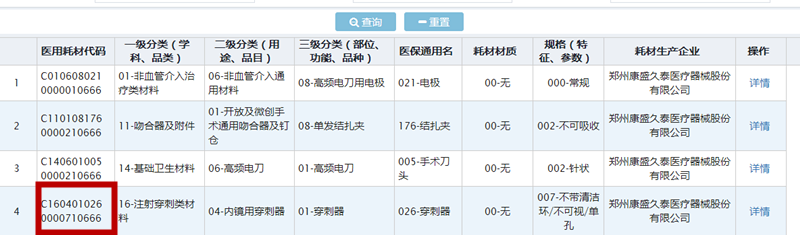
                                                                                 

So what do all these numbers represent?


The NHSA, in the "Rules and Methods for Medical Insurance Disease Diagnosis and Surgical Procedures, Drugs, Medical Service Items, and Medical Consumables Information Business Coding," demonstrated the coding of medical insurance medical consumables:
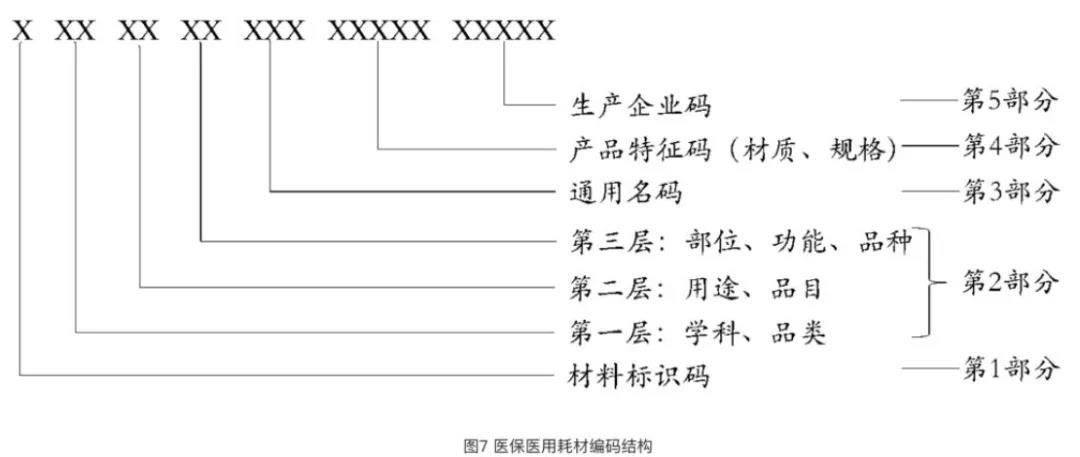
                                                                                 

(Image source: National Healthcare Security Administration)

Interpretation: The medical insurance medical consumable code is divided into 5 parts with a total of 20 digits, represented by uppercase English letters and Arabic numerals arranged in a specific order. The first part is the consumable identification code, the second part is the classification code, the third part is the generic name code, the fourth part is the product characteristic code, and the fifth part is the manufacturer code.


Part 1: Consumable identification code, represented by the uppercase English letter "C".

Part 2: Classification code, divided according to the medical consumable discipline, use, location, and function, represented by 6 Arabic numerals.

Part 3: Generic name code, creating a nationally unified generic name code for medical insurance medical consumables, represented by 3 Arabic numerals.

Part 4: Product characteristic code, a code assigned according to the material and specifications of the consumable, represented by 5 Arabic numerals.

Part 5: Manufacturer code, a unique code assigned to the consumable manufacturer based on the medical device registration certificate or filing certificate, represented by 5 Arabic numerals.

This includes a total of 32,554 medical insurance medical consumable codes, covering 9,404,543 actual specifications of medical consumables.

                                                                             

III. Local Medical Insurance Departments Must Not Adjust Arbitrarily


On June 8, the NHSA released the "Draft for Comments on the Provisional Measures for the Management of Medical Consumables under the Basic Medical Insurance," the structure of which mainly includes two parts: the preface and the catalog.

                                                                            

The preface explains and describes the arrangement format, name and coding standards, and payment scope of the "Basic Medical Insurance Medical Consumables Catalog." The catalog includes the number, functional classification, medical insurance code, payment scope, unit price, payment standard, method for determining the payment standard, and remarks.


The "Draft for Comments" emphasizes that, except as otherwise specifically provided, local medical insurance departments must implement the national "Basic Medical Insurance Medical Consumables Catalog" and must not adjust it arbitrarily.


It is understood that the medical consumables referred to in these measures are medical consumables that have been approved by the drug supervision and administration department, can be charged separately, and have a unified medical insurance medical consumable code. The medical insurance access, payment, and corresponding management and supervision of medical consumables are applicable to these measures.


According to the "Draft for Comments," the medical insurance fund will not pay for medical consumables in the catalog under any of the following circumstances: 1. Used for non-disease treatment projects; 2. Used for various research and clinical verification treatment projects; 3. Exceeding the reasonable scope of use; 4. Other circumstances that do not comply with the payment scope of basic medical insurance.


The medical insurance fund and the patient will not pay for medical consumables in the catalog under any of the following circumstances: 1. Unsuccessful use due to the consumable itself; 2. Implantable consumable costs exceeding the actual number implanted.


Medical consumables in the "Basic Medical Insurance Medical Consumables Catalog" must meet the following conditions simultaneously for the medical insurance fund to pay: 1. For the purpose of disease diagnosis and treatment; 2. Comply with the scope of application registered or filed with the drug supervision and administration department; 3. Comply with the payment scope specified in the "Basic Medical Insurance Medical Consumables Catalog"; 4. Prescribed by medical personnel with the corresponding qualifications from designated medical institutions (emergency rescue can be appropriately relaxed to non-designated medical institutions); 5. Other conditions stipulated by the state.

IV. Consumable Coding Involves Payment and Settlement


It can be seen that the work on medical consumable coding, which has been a focus of attention in the medical field, has officially begun. By 2020, based on the construction of a unified national medical security information system, the implementation of 15 information business coding standards, including disease diagnosis and surgical procedures, will be gradually realized.


Unlike drugs, consumables are not only numerous but also diverse. The names of the same product are different in different regions during bidding and procurement, and the policies and regulations on consumables vary from place to place, causing many inconveniences to the bidding, procurement, and payment of consumables.


In this situation, some companies have taken advantage of this to evade price supervision, and some regions have even formed mixed business models. One of the purposes of the consumable procurement alliance that has emerged in recent years is to implement practices such as sharing consumable procurement prices and data to avoid this practice by companies.


The emergence of medical consumable coding standards will inevitably change and correct certain aspects of the consumable industry chain to cooperate with the medical insurance disease diagnosis and surgical procedure information business coding standards that have also been a key focus in the early stages. In fact, due to the lack of unified standards, companies themselves often do not know the names and information of their products in bidding and procurement in multiple places. For example, the product name is a in Beijing, but it becomes b in Nanjing.


Conclusion


This "consensus" will directly affect the bidding, procurement, and payment processes for consumables. Previously, consumables were complex and disorganized; the coding standard will change this chaotic situation, eliminating problems in the bidding and procurement processes caused by poor product information, and subsequently impacting the payment process.

Source: Cyber Blue Medical Devices

Keywords: